7 regions of the Moscow cluster
In the M6 pilot (October 2026) the service launches in the Tver Region. Expansion to the remaining 6 regions is planned for March–April 2027 once FSTEC IS Class 2 certification has been obtained.
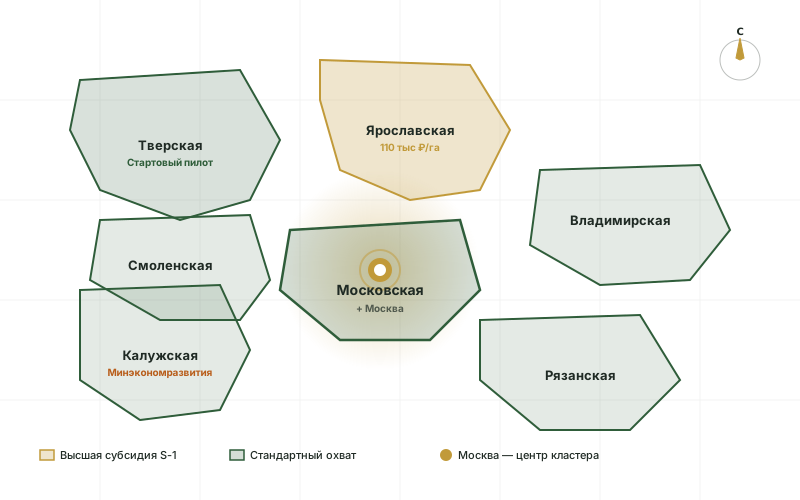
Pilot launch — Tver Region. Full coverage — April 2027.
Tver Region
250 thousand hectares of fallow land. According to Tverlife data for Q1 2026, 99% of inspected plots are in violation. A huge funnel for S-1 (Land Use Restoration). The regional Ministry of Agriculture takes an active stance.
The "Development of Agriculture in the Tver Region" programme for 2022–2027 — subsidies for bringing fallow land back into use. Declarations to the Ministry of Agriculture are due by 1 March.
Yaroslavl Region
400 thousand hectares of fallow land — the largest funnel in the cluster. The regional compensation programme makes S-1 economically viable even with hired contractors: preparatory works are reimbursed.
The "Development of the Agro-Industrial Complex of the Yaroslavl Region" programme for 2024–2030. Base subsidy of 70K RUB/ha, with up to 110K RUB/ha for priority crops.
Kaluga Region
Decisions on land seizure are taken by the Ministry of Economic Development (rather than the Ministry of Agriculture, as in other regions). This is critical for court jurisdiction and for the addressee of submissions. AI-3 takes this into account.
A developed agro-industrial infrastructure. Proximity to the Vorotynsk / Vorsino / Grabtsevo industrial parks makes S-4 (Land Category Conversion) profitable.
Moscow Region
The most "expensive" region in the cluster. Significant potential for strategy S-4 (Land Category Conversion) for plots adjoining the boundaries of populated areas. Regional Law 75/2004-OZ sets out the specifics of land turnover.
Notice to co-owners is published in "Yezhednevnye Novosti. Podmoskovye". The "Moscow Region Agro-Industrial Complex 2025-2030" programme.
Ryazan Region
A traditionally strong agricultural region of the Central Federal District. An active regional programme of support for farming simplifies S-2 (Lease to Farmer). The shortage of lessees is local rather than systemic.
Regional Law 33-OZ. Notices are published in "Ryazanskie Vedomosti". The "Development of the Agro-Industrial Complex of the Ryazan Region" programme.
Smolensk Region
Districts remote from Moscow with low land prices and active seizure proceedings. There is a shortage of lessees in the more distant districts — strategy S-2 is often inapplicable. S-1 (restoration) and S-5 (sale at a discount) work well.
A large number of violations were identified in 2025–2026. The "Development of Agriculture in the Smolensk Region" programme.
Vladimir Region
A balance between proximity to Moscow (where conversion to individual housing construction is achievable) and remote agrarian districts. The Aleksandrov, Kolchugino and Yuriev-Polsky districts feature a high concentration of fallow land.
Regional Law 39-OZ. Notice to co-owners is published in "Vladimirskie Vedomosti". A portion of the land is the legacy of collective-farm privatisation, with a large number of co-owners.
Regions × strategies
Not every strategy works equally well in every region. This table is the foundation of the AI-6 algorithm when selecting the optimal route for a specific case.
| Region | S-1 restoration | S-2 lease | S-3 PUT | S-4 conversion | S-5 sale | S-6 challenge |
|---|---|---|---|---|---|---|
| Tver | ✓ | ~ | ✓ | ~ | ✓ | ✓ |
| Kaluga | ✓ | ✓ | ✓ | ✓✓ | ✓ | ⚠ |
| Moscow | ✓ | ✓✓ | ✓ | ✓✓✓ | ✓ | ✓ |
| Smolensk | ✓ | ~ | ✓ | ~ | ✓ | ✓ |
| Vladimir | ✓ | ✓ | ✓ | ~ | ~ | ✓ |
| Ryazan | ✓ | ✓✓ | ✓ | ~ | ✓ | ✓ |
| Yaroslavl | ✓✓✓ | ✓✓ | ✓ | ~ | ✓ | ✓ |
Legend: ✓✓✓ — strongly recommended (regional factor makes it advantageous); ✓✓ — well suited; ✓ — generally applicable; ~ — applicable with limitations; ⚠ — procedural specifics apply.
Regional support programmes for S-1
When strategy S-1 (Land Use Restoration) is chosen, the state in most regions reimburses part of the costs. AI-3 takes the regional subsidy into account when generating the Restoration Plan.
Yaroslavl
priority crops
"Development of the Agro-Industrial Complex of the Yaroslavl Region" 2024–2030. Base subsidy of 70K RUB/ha, up to 110K RUB/ha for priority crops (rapeseed, flax, wheat).
Moscow
+ reclamation reimbursement
"Moscow Region Agro-Industrial Complex 2025-2030". A high base subsidy plus additional reimbursement of land-reclamation works for plots with low fertility.
Tver
+ liming
"Development of Agriculture in the Tver Region" 2022–2027. Includes reimbursement of preparatory works and soil liming.
Ryazan
+ farmer support
"Development of the Agro-Industrial Complex of the Ryazan Region". Additional support programmes for early-stage farmers, simplifying S-2 (Lease to Farmer).
Subsidy amounts and conditions are based on open sources as of May 2026. They are updated quarterly via the regional Ministry of Agriculture.